


Products
Force, Position, HMI, Gas Sensing, Smart Textile, and Printed Electronics Products
Interlink Electronics is a leading provider of sensors and printed electronic solutions, with 40 years of experience delivering mission-critical technologies. Our products serve global blue-chip customers in medical, industrial, automotive, wearables, IoT, environmental air quality, and specialty markets. We leverage expertise in materials science, manufacturing, embedded electronics, firmware, software, machine learning and artificial intelligence to develop custom solutions for our clients' specific needs.
Categories
Force sensing, position sensing, HMI and user interface products, gas sensing and instruments, smart textiles and wearables, membrane keypads, interface assemblies, graphic overlays, labels, printed electronics, diagnostic electrodes, and printed heaters.
Catalog Controls
Sensor platforms trusted by major OEMs across demanding applications
Interlink combines vertically integrated design, manufacturing, and engineering expertise with a strong IP portfolio of 49 issued patents and 14 additional patents pending across sensing and printed electronics technologies.
117 items shown
All categories selected
Force Sensing Resistors
Force Sensing Resistors
Interlink pioneered FSR technology and continues to offer ultrathin force sensors that provide reliable, measurable response across a wide range of applications.
40 products in this section


Supporting Information
Force Sensing Resistor (FSR) Sensor Series
Force Sensing Resistor technology from Interlink is designed for teams that need repeatable pressure input with low profile integration options.
Interlink invented the Force Sensing Resistor and brought it to market in 1985. The architecture uses a printed interdigitated circuit and conductive layer that decreases resistance as applied force increases, enabling predictable, analog force interpretation in compact form factors.
The standard FSR portfolio includes high-performance options such as the UX 400 series (0.5 N to 150 N), the X 400 series (0.3 N to 50 N), and the original 400 series (0.2 N to 20 N). This range supports design-in across medical interfaces, industrial controls, robotics, and consumer electronics.
For rapid evaluation, Interlink also offers hardware development kits with sensor variations, overlays, and adhesive options so teams can validate force behavior before committing to production geometry and stack-up decisions.
Position Sensing
Position Sensors
Interlink position sensing products apply force-based touch detection to linear and 360-degree controls, giving designers intuitive navigation options in tight spaces.
4 products in this section


Position Sensing
FSLP Sensor
A linear position sensor with simultaneous force detection. Easy to integrate, high resolution, ultra-low power — ideal for media players, mobile phones, control panels, medical instruments, and home entertainment devices.
Contact to learn more

Position Sensing
FSLP Sensor HDK
Complete hardware development kit for evaluating and prototyping the FSLP linear position sensor. Includes a fully functioning demo board, spare sensors, connectors, and reference documentation.
Contact to learn more

Position Sensing
Ring Sensor HDK
Complete hardware development kit for evaluating the Ring Sensor — a rotary membrane potentiometer for menu navigation, audio balance, and media control in compact products.
Contact to learn more
Supporting Information
Position Sensors
Interlink position solutions extend core force-sensing capabilities into touch-driven position control for menu navigation and embedded interface design.
The Force Sensing Linear Potentiometer (FSLP) detects position along a straight path, making it useful for volume sliders, linear movement controls, and home automation interactions where users expect smooth, tactile navigation.
The Ring Sensor uses related force sensing principles in a 360-degree format, giving teams a dial-like interface pattern that can be integrated into compact industrial and consumer products without adding complex mechanics.
For early-stage design and prototyping, Interlink offers HDK options with sensor and connector variations. If standard shapes are not a fit, the custom solutions team can modify dimensions, geometry, and stack-up details for application-specific position sensing requirements.
HMI & Pointing
Mouse, Pointing, & Touchpad Products
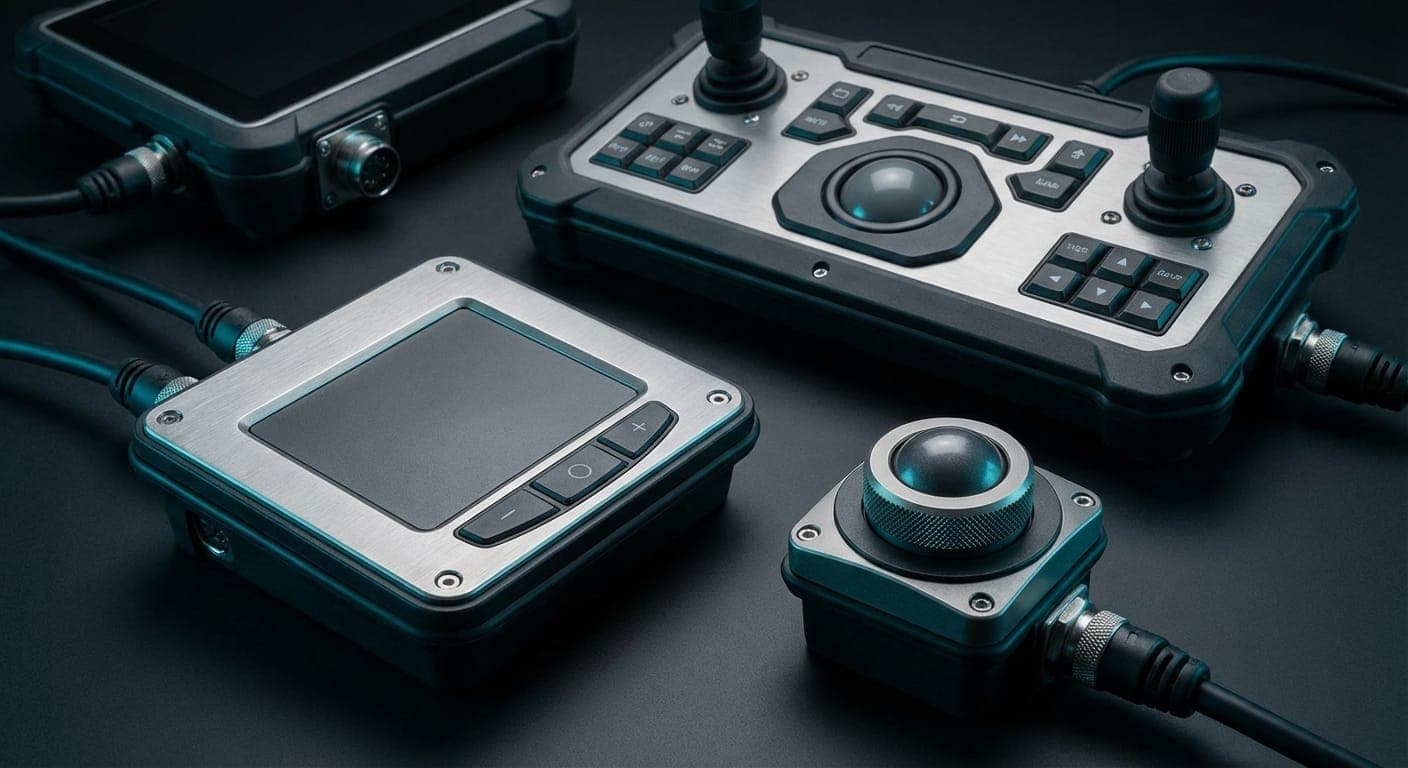
Interlink HMI modules combine rugged construction with intuitive input behavior for factories, medical environments, ruggedized devices, and other demanding deployments.
13 products in this section


HMI & Pointing
4-Zone FSR® Mouse Sensor
Ultra-thin 4-zone Force Sensing Resistor mouse pointing sensor. Paired with an actuator and controller IC, delivers accurate 360° mouse control in space-constrained designs.
Contact to learn more

HMI & Pointing
4-Zone FSR® Mouse Sensor HDK
Complete hardware development kit for evaluating and prototyping the 4-Zone FSR mouse pointing solution. Includes a fully functioning demo module, multiple sensor variants, and programmed microcontrollers.
Contact to learn more

HMI & Pointing
DuraPoint®
A fully sealed, submersible industrial mouse with no moving parts. Built for factories, warehouses, service bays, operating rooms, and the harshest desktop environments.
Contact to learn more

HMI & Pointing
DuraPoint® OEM
A rugged, easy-to-integrate OEM mouse module for industrial computers, process automation systems, industrial keyboards, vision inspection systems, and military computers.
Contact to learn more

HMI & Pointing
MicroJoystick
High-precision OEM pointing system that delivers simultaneous 360° control of direction and speed at the touch of a fingertip. Based on patented FSR® technology.
Contact to learn more

HMI & Pointing
MicroJoystick HDK
Complete hardware development kit for evaluating the MicroJoystick 4-zone mouse pointing solution. Includes a fully functioning demo module, spare components, and reference materials.
Contact to learn more

HMI & Pointing
MicroModule
Miniature finger-actuated pointing module providing simultaneous 360° directional and pressure-based speed control. Ideal for rugged, embedded, and space-constrained applications.
Contact to learn more

HMI & Pointing
MicroModule HDK
Complete hardware development kit for evaluating and integrating the MicroModule finger-actuated pointing solution. Includes a fully functioning demo, keypad, cables, and reference documentation.
Contact to learn more

HMI & Pointing
MicroNav 360
A 360° micro-pointing sensor built on patented Force Sensing Resistor (FSR®) technology. Designed for keyboards, tablet PCs, and remote controls.
Contact to learn more
Supporting Information
Human-Machine Interfaces (HMI) & Pointing Solutions
Interlink HMI and pointing products are built for users who need dependable control interfaces beyond office and desktop conditions.
The standard lineup spans resistive touchpads like VersaPad, joystick modules such as MicroJoystick, and industrial pointing devices including DuraPoint. These modules can add touchpad and directional control behavior to a wide range of electronic products.
Interlink’s HMI products emphasize rugged design principles for real-world use. When properly integrated, they are engineered to tolerate spills, dirt, vibration, and temperature stress in markets like healthcare, industrial automation, and field equipment.
Unlike many capacitive-only interfaces, these force-based and resistive solutions can be used with gloves, which is often required in hospitals, factories, and maintenance environments. HDK options are available to accelerate evaluation during design and prototyping.
Gas Sensors
Gas Sensing Products
A unified gas-sensing catalog covering sensor elements, modules, monitors, analyzers, and connected wearables across the Interlink product portfolio.
48 products in this section
Filter by gas type

Gas sensors
Gas Sensing Elements
Electrochemical sensing elements and bare gas sensors for OEM integration and application-specific gas detection.

Gas sensors
Gas Sensor Modules
Signal-conditioned analog and digital modules that package gas sensing, compensation, and interface electronics.


Shoppable
Electrochemical Ozone Sensor Modules
$750.00
Gas sensors
OEM Boards & Integration
Board-level and application-specific gas sensing pathways for embedding detection into customer systems.


Gas Sensors
OEM-1 Ozone Detection Board
Contact-led OEM ozone detection board for embedding Eco Sensors-style ozone detection into customer equipment and application-specific systems.
Contact to learn more

Gas Sensors
OEM-2 Ozone Detection Board
Contact-led OEM ozone detection board for custom embedded ozone monitoring, control, and equipment-integration programs.
Contact to learn more
Gas sensors
Development Kits
Evaluation and developer tools for validating gases, interfaces, and integration approaches before production.
Gas Sensors
DGS2 Digital Gas Sensor Developer Kit
Developer kit configuration for evaluating DGS2 digital gas sensor modules before OEM integration.
$370.00
Gas sensors
Handheld & Portable Instruments
Field-portable instruments for surveys, diagnostics, leak checks, and on-site gas measurement workflows.


Gas sensors
Monitors & Controllers
Fixed and continuous monitoring products for facility safety, ozone control, alarms, and building systems.


Gas sensors
Inline Gas Monitors
Inline monitoring systems for compressed air, process lines, and continuous industrial measurement.

Gas Sensors
A316 Inline CO Monitor and Alarm
Inline carbon monoxide monitor and alarm for compressed-air systems, with 115 VAC power, dust-resistant surface-mount enclosure, digital ppm display, internal alarm relay, and 4-20mA output terminals.
Contact to learn more
Gas sensors
Precision Analyzers
Analyzer-class ozone and gas measurement products for higher-confidence measurement and validation programs.

Gas sensors
Wearable & Connected Monitors
Personal, wearable, and connected gas monitors for exposure awareness and mobile environmental monitoring.

Gas sensors
Accessories
Supporting accessories, replacement parts, calibration tools, and integration components.


Shoppable
Electrochemical Ozone Sensor Modules
$325.00
Supporting Information
Gas Sensing Products
Interlink now covers gas sensing from raw electrochemical elements through finished monitors, analyzers, and connected wearables.
The portfolio spans electrochemical gas sensor elements, digital and analog modules, environmental instruments, ozone analyzers, portable detectors, fixed monitors, inline systems, and connected wearables for OEM and commercial deployments.
This range supports product selection across air-quality monitoring, industrial safety, facility sensing, consumer wearables, and application-specific gas detection programs without fragmenting the experience across separate brands.
On this page, gas-related products are grouped together so users can browse the broader Interlink gas portfolio in one place while still reaching the right technical path for product follow-up.
Smart Textiles and Wearables
Smart Textile Products
Printed stretchable circuits, textile heaters, textile sensors, and cross-seam connections for e-textiles, medical garments, and wearable electronics.
5 products in this section


Smart Textiles and Wearables
ElastaMoist
Advanced moisture-sensing technology for femtech, health monitoring, and medical smart-garment applications.
Contact to learn more

Smart Textiles and Wearables
ElastaSens
A family of printed sensors including capacitive, touch, stretch, and pressure sensing elements designed for integration into fabric. Enables intelligent garments that respond to body position and movement.
Contact to learn more

Smart Textiles and Wearables
ElastaTherm
Screen-printed heating elements integrated directly into fabric substrates. Positive temperature coefficient (PTC) inks self-regulate temperature for safety and efficiency, with rapid heat-up and thicknesses as low as 0.1 mm.
Contact to learn more

Smart Textiles and Wearables
ElastaTrode
Printed circuit technology for smart textiles and medical garments, with FDA and CE-approved use cases in wearable therapeutic and sensing programs.
Contact to learn more

Smart Textiles and Wearables
FES Electrodes
Stretchable printed electrodes for Functional Electrical Stimulation (FES) applications, supporting neuromuscular rehabilitation for stroke patients. Circuits are thin, light, comfortable, and clinically effective.
Contact to learn more
Supporting Information
Smart Textiles and Stretchable Electronics
Interlink smart textile products support garments, wearable heating, textile sensing, and printed circuits laminated directly onto fabric.
The smart textile portfolio is built around stretchable printed electronics that can be integrated into textile substrates without conventional rigid boards or wire harnesses. That opens up product paths for heated apparel, body-worn sensing, rehabilitation garments, and other e-textile programs.
Current families include ElastaTherm heating elements, ElastaTrode printed textile circuits, ElastaSens textile sensors, ElastaMoist moisture sensors, and FES electrodes for rehabilitation and stimulation workflows.
Membrane Keypads
Membrane Keypads
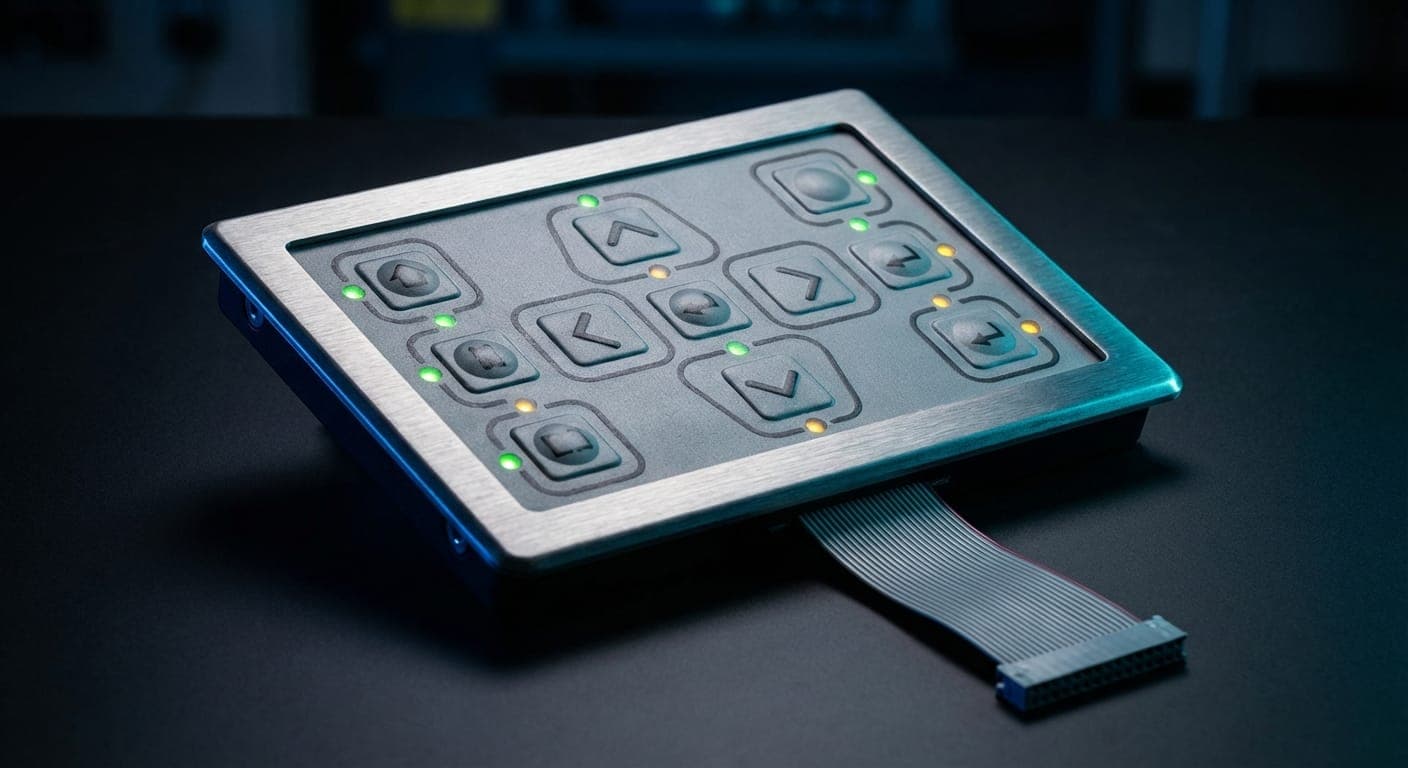
Engineered membrane keypad programs with tactile and non-tactile constructions, integrated circuitry, LEDs, shielding, and rugged industrial finishes.
1 products in this section
Membrane Keypads
Membrane Keypads
Calman membrane keypad programs support polydome and metal-dome tactile constructions, integrated LEDs, shielding, and a broad range of print and surface finishes for rugged industrial use.
Contact to learn more
Supporting Information
Membrane Keypads
Interlink supports membrane keypad development across self-adhesive builds, PCB-backed constructions, tactile dome architectures, and fully integrated interface assemblies.
These keypad programs are suited to industrial, electronics, and OEM interface requirements where enclosure fit, circuitry integration, tactile feel, and environmental durability all matter. Early design collaboration is a core part of the product-development process.
The category supports a broad set of surface finishes, embossing options, switch constructions, and integrated electronic features including LEDs and shielding.
Interface Assemblies
Interface Assemblies
Integrated HMI assemblies combining membrane keypads, overlays, circuitry, lighting, shielding, adhesives, and mechanical fit into one front-panel system.
1 products in this section

Interface Assemblies
Interface Assemblies
Custom front-panel assemblies that combine graphics, switching, circuitry, lighting, shielding, adhesives, and enclosure-ready fit.
Contact to learn more
Supporting Information
Interface Assemblies
Interface assemblies are for OEM programs that need the full front-panel system engineered together rather than separate keypad, overlay, and electronics components.
Interlink can support membrane switching, graphic layers, printed circuitry, LEDs, shielding, adhesives, and mechanical integration as one coordinated assembly. This is useful when the user interface needs to fit the enclosure, electronics, labeling, tactile behavior, and environmental requirements from the beginning of the design process.
These programs are typically specification-led and are best handled through a design review so the final construction can be matched to the device architecture, production volume, and field environment.
Graphic Overlays
Graphic Overlays
Custom branded overlays with digital print, windows, embossing, switch access, and durable adhesives for control surfaces and front-panel systems.
1 products in this section

Graphic Overlays
Graphic Overlays
Graphic overlays are produced for direct device integration with options for digital printing, durable adhesives, and additional finishing features tuned to application and environmental requirements.
Contact to learn more
Supporting Information
Graphic Overlays
Graphic overlays are used where product interfaces need durable branded surfaces, display windows, switch access, and strong visual communication.
These overlay programs support self-adhesive front layers with clear or tinted windows, through-holes, embossing, insert pockets, and digitally enhanced graphics. They are frequently paired with membrane keypads, microswitches, or PCB-based switching architectures.
This category is especially relevant for OEMs that need both functional interface protection and polished front-panel branding in a single engineered part.
Labels
Labels
Industrial labels, rating labels, barcode and QR-coded labels, and branded badges with adhesives and finishing matched to the end product.
1 products in this section

Labels
Labels
Calman label products are available with QR and barcodes, supporting traceability and product identification workflows across industrial and electronics manufacturing environments.
Contact to learn more
Supporting Information
Labels
Interlink label products support product identification, traceability, instruction, branding, and code-ready manufacturing workflows across industrial and electronics programs.
The category covers everything from simple decals to intricate multi-colour labels and product badges. CNC cutting enables complex geometries without expensive hard tooling, and coordinated production with keypads or overlays keeps finish and colour consistency tight.
Because label requirements are usually specification-led, these items are presented here as contact-led products rather than shoppable checkout items.
Printed Electronics
Printed Electronics
Printed conductive, resistive, and insulating layers for flexible electronics, heating, shielding, and sensor-enabled assemblies across the Interlink product portfolio.
1 products in this section

Printed Electronics
Printed Electronics
Printed electronics services deliver lower-cost alternatives to copper-clad flex circuits for suitable use cases, while enabling rapid iteration and application-specific material stacks.
Contact to learn more
Supporting Information
Printed Electronics
Printed electronics extends Interlink beyond traditional sensors into flexible functional layers for control, thermal, shielding, and sensing applications.
Interlink supports printed electronics through additive and subtractive process combinations, conductive and insulative inks, and cost-effective prototyping paths. These offerings fit OEM teams that need custom electronic functionality in compact or flexible packages.
Together with Interlink sensing and interface programs, this category helps position the site as a broader product and technology system rather than only a sensor catalog.
Diagnostic Electrodes
Diagnostic Electrodes
Printed electrode and body-contact constructions for medical, diagnostic, stimulation, and wearable monitoring programs.
1 products in this section
Diagnostic Electrodes
Diagnostic Electrodes
Printed electrode structures for diagnostic, stimulation, rehabilitation, and body-near wearable programs.
Contact to learn more
Supporting Information
Diagnostic Electrodes
Diagnostic electrode programs extend Interlink printed electronics into body-contact and medical-adjacent applications where comfort, repeatability, and conductive performance matter.
These products can include printed conductive layers, stretchable electrode geometries, textile-compatible structures, and application-specific stack-ups for diagnostic, rehabilitation, stimulation, or wearable monitoring workflows.
Because electrode designs are usually application-specific, this category is presented as a contact-led product path rather than a generic off-the-shelf checkout item.
Printed Heaters
Printed Heaters
Printed heating elements and thermal layers for garments, seats, medical warming, PPE, and compact product assemblies.
1 products in this section
Printed Heaters
Printed Heaters
Low-profile printed heating elements for garments, seating, medical warming, PPE, and flexible surface integration.
Contact to learn more
Supporting Information
Printed Heaters
Printed heater programs use functional printed layers to deliver low-profile thermal performance directly into textiles, surfaces, or compact assemblies.
Interlink can support printed heating elements for smart garments, automotive seating, medical warming products, PPE, and other applications where conventional wire heater mats create too much bulk or limit product design.
These programs often involve thermal performance, comfort, washability, safety behavior, and manufacturing constraints, so they are best evaluated as a custom printed-electronics or wearable-system program.
As Seen In
Company coverage and credibility signals
Nasdaq
Public market listing (LINK)
Interlink Press Room
Official press releases and announcements
SEC Filings
Regulatory filings and disclosures
Analyst Coverage
Coverage and investor references
Customer Proof